Airbnb in Aysen: Vacation Rental Rules, Taxes and Real ROI in Chilean Patagonia
TL;DR Running an Airbnb in Aysen is legal, increasingly formalized, and seasonally lucrative. Furnished rentals pay 19% IVA (with a deduction based on your property’s fiscal valuation), rental income is regular taxable income, and since 2026 platforms like Airbnb must verify that hosts are registered with the SII. SERNATUR registration is mandatory for tourist accommodation, not optional. The demand side is the good news: Aysen welcomed roughly 230,000 visitors in the 2025-2026 summer season, and Coyhaique-Puerto Aysen posted 89.9% occupancy in February, the highest in Chile. The catch is seasonality: winter occupancy drops to the mid-teens, so your business plan needs to survive on four strong months.
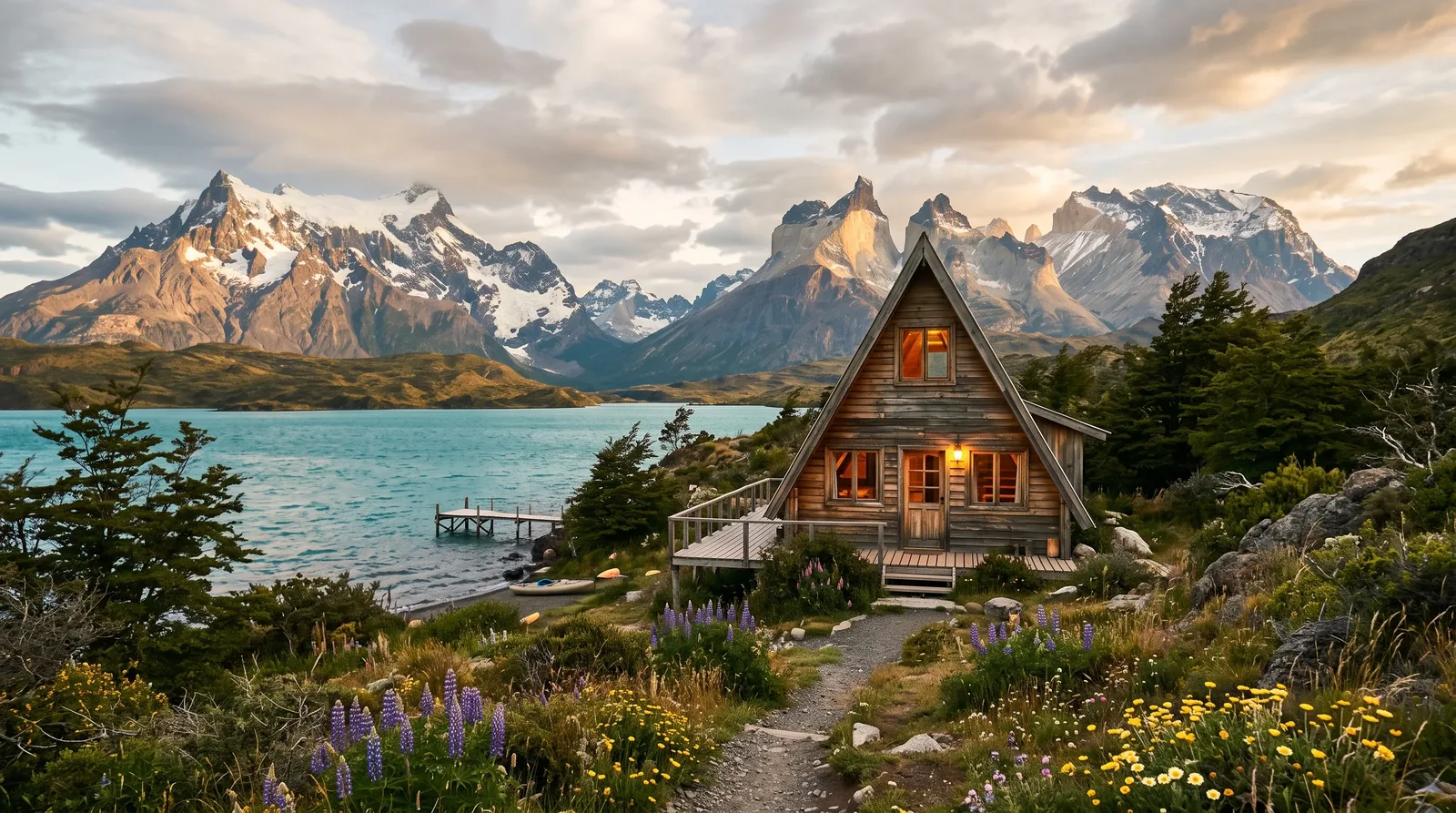 The archetypal Patagonian rental: a cabin, a lake, a mountain. Browse cabins for sale across the Aysen Region.
Every second inquiry we get about investing in Patagonia ends with the same question: “Could I Airbnb it when I’m not there?” It is a fair question. The Carretera Austral has become one of South America’s marquee road trips, summer occupancy in parts of Aysen now leads the entire country, and a well-placed cabin can out-earn a long-term lease several times over during the high season.
But between the daydream and the deposit sits a stack of Chilean acronyms: IVA, SII, SERNATUR, DFL 2, patente comercial. None of them are deal-breakers. All of them are real. This guide walks through the rules as they actually stand in mid-2026, the demand data straight from official sources, and an honest framework for estimating returns in a market where glossy analytics dashboards have no coverage.
One disclaimer up front: this is a general guide, not tax or legal advice for your situation. Chilean tax treatment depends on your residency, structure, and how many properties you own. Get a contador. They are cheap by international standards and worth every peso.
The demand side: what official numbers say about Aysen tourism
Start with why this conversation is happening at all. Aysen is not a mature, saturated market like Pucon or San Pedro de Atacama. It is the frontier that finally got discovered, and the official statistics back that up.
According to SERNATUR’s regional balance of the 2025-2026 season, an estimated 229,947 visitors entered the region between December 2025 and March 2026. Arrivals at tourist accommodation establishments grew 7.1% while the national figure actually fell 2.5%. Read that again: Chile’s overall tourism receded and Aysen grew anyway.
The occupancy numbers are the headline for any would-be host. Hotel occupancy in the region reached 76.8% in January and 75.7% in February 2026, both above the national average, and the Coyhaique-Puerto Aysen destination hit 89.9% occupancy, the best in the entire country.
Numbers That Matter: In February 2026, Coyhaique-Puerto Aysen posted 89.9% accommodation occupancy, the highest of any destination in Chile. Not Patagonia. Chile.
The longer trend supports it. The Barometro Turistico for full-year 2024, compiled by SERNATUR Aysen and the regional government, shows Balmaceda airport received 310,876 passengers in 2024, up 4.7% on 2023. Foreign arrivals through the region’s land borders jumped 50.5% to 108,703, driven overwhelmingly by Argentine travelers: 90,172 of them, up 70.1% in a single year, part of a national surge linked to the exchange-rate shift since March 2024.
And the product they come for keeps getting more famous. The Carretera Austral corridor concentrates more than 240 tourist attractions along roughly 1,240 kilometers, with Puerto Rio Tranquilo serving as the gateway to the Marble Caves and the Exploradores Glacier. If you have driven the route in February, you already know: the bottleneck is not demand, it is beds.
The seasonality problem nobody puts in the brochure
Now the cold shower, literally. Aysen’s demand is violently seasonal, and the official data quantifies exactly how much.
The same Barometro Turistico reports February 2024 spot occupancy of 80.6% in Coyhaique-Aysen, 75.5% in the northern Carretera Austral and Queulat zone, and 76.4% around Lago General Carrera. But the region-wide monthly averages tell the winter story: January 2024 averaged 34.6%, February 38.0%, and the June-July trough sat around 14 to 16%. December, the shoulder of the high season, managed only 26.6%.
Two lessons hide in those numbers. First, the spread between destination hot spots and the regional average is enormous: location within Aysen matters more than almost anything else. Second, your spreadsheet cannot assume smooth year-round income. The realistic model is four strong months (December through March), two decent shoulders, and a winter where the Carretera Austral is quiet, some services close, and bookings become a trickle.
Pro Tip: Winter does not have to mean zero. Coyhaique has year-round administrative, university and commercial activity, and a growing stream of remote workers looking for medium-term stays. Many hosts switch to monthly furnished rentals from May to September and back to nightly rates in November.
The tax framework: IVA is the rule, not the exception
Here is the part that surprises almost every new host: in Chile, renting out a furnished property is subject to IVA, the 19% value-added tax. This is not an Airbnb-specific rule and it is not new. The SII confirms that furnished property rental is taxed with IVA under Article 8, letter g of the sales tax law (DL 825). A vacation cabin rented with beds, a stove and a kettle is, by definition, furnished.
The mechanics are more manageable than they sound:
- The taxable base gets a discount. When calculating the IVA you owe, you first deduct 11% of the property’s avaluo fiscal (its official tax valuation), applied proportionally to the rental period. For properties with modest fiscal valuations rented by the night, this deduction meaningfully reduces the bill.
- You declare monthly on Formulario 29. Occasional, non-habitual landlords can declare directly online using code 713; habitual operators must formally register their activity (inicio de actividades) with the SII.
- The obligation is yours, not Airbnb’s. In Oficio 1.768 of September 2024, the SII clarified that platforms act as intermediaries: their commission carries its own IVA, but the tax on the rental itself is charged and paid by the host.
On top of IVA, the rental income itself is taxable. Income from real estate is First Category income that flows into your annual Global Complementario return, and the SII now offers a dedicated assistant for declaring rental income at Operacion Renta. Non-resident owners have their own withholding regime, which we covered in detail in our guide to Chilean rental income tax for foreign owners. Airbnb itself publishes an official Chilean tax guide for hosts that says essentially the same thing: this income is not invisible and not exempt.
The DFL 2 myth, updated for 2026
Chilean forums love to claim that DFL 2 properties (viviendas economicas, homes under 140 m2 built) make rental income tax-free. There is real law behind the claim: DFL 2 of 1959 does treat rental income from qualifying homes as non-taxable income. But two things changed.
First, Ley 21.420 narrowed the benefit from January 2023: it now applies only to natural persons and only to their first two DFL 2 properties, counting inherited ones. Own three, and only the two oldest acquisitions keep the benefit.
Second, and this is the trap for hosts: DFL 2 is an income tax benefit. It does not touch IVA. A furnished tourist rental in a DFL 2 house still triggers the Article 8 letter g IVA rules above. Plenty of hosts learned this distinction the expensive way.
Important: DFL 2 can shelter your rental income from income tax (two properties, natural persons only), but it does not exempt a furnished vacation rental from 19% IVA. Two different taxes, two different laws.
The SII can see you now: platform reporting since 2023, verification since 2026
For years, the polite fiction of Chilean short-term rentals was that nobody was watching. That era is over, in three documented steps.
Step one, 2023: mass reporting. SII Resolution 98 of August 2023 expanded the annual sworn declaration on leased properties (DJ 1835) to explicitly cover brokers and intermediaries of furnished rentals, platforms included, reporting properties, owners and tenants each March. Airbnb openly confirms it shares host data with Chilean authorities.
Step two, 2025: platforms must ask for your papers. Under Ley 21.713 and SII Circular 38 of April 2025, digital intermediation platforms and payment processors must require proof of inicio de actividades from users carrying out habitual economic activity. The SII named short-term rental platforms like Airbnb and Booking explicitly.
Step three, 2026: platforms must verify. Since January 1, 2026, those platforms must additionally verify the tax compliance of their users, per the same Circular 38 timeline. In practice: a habitual host without SII registration is now a problem for Airbnb itself, which gives the platform every incentive to push you into formality or off the platform.
Meanwhile, there is still no dedicated short-term rental law in Chile. A bill capping whole-home platform rentals at 90 days per year (Boletin 12.978-03, filed in 2019) remains parked in its first legislative stage with no urgency. Regulation, as of mid-2026, is happening through the tax system, not a tourism statute. For an investor, that is actually good news: the rules are knowable, and compliance is a process, not a lottery.
 Formalizing a rental is paperwork, not heroics. Our team can point you to local accountants: contact us.
The formalization checklist: from purchase to first guest
Chile’s tourism authorities publish an official pathway for legalizing accommodation, the Ruta de la Formalizacion. Condensed, it looks like this:
- Inicio de actividades with the SII. Your formal registration as a taxpayer with an economic activity. Free, online, and now effectively demanded by the platforms themselves (see above).
- Resolucion sanitaria from the regional Seremi de Salud. A sanitary authorization confirming the property is fit to host guests.
- Patente comercial from your municipality. The municipal business license. Requirements typically include your SII registration, the sanitary resolution, and zoning or reception certificates from the municipal works department, and details vary by comuna: Coyhaique, Rio Ibanez and Cisnes each run their own counter.
- Registration with SERNATUR. Here is the one everyone gets wrong: SERNATUR’s registry is voluntary for most tourism services but explicitly mandatory for tourist accommodation, under Ley 20.423 and its 2018 regulation. Registration is free and done online via ChileAtiende, and you need your patente first.
Did You Know: SERNATUR registration is legally mandatory for anyone offering tourist accommodation in Chile, cabins and Airbnbs included. It is also free, which makes skipping it a strange place to economize.
Buying an apartment instead? Check the condominium rules
If your plan is a Coyhaique apartment rather than a standalone cabin, one more layer applies. The 2022 condominium law, Ley 21.442, lets each building’s internal regulations set rules for units used as “temporary lodging, tourist accommodation, apart-hotel or similar”: guest registration, common-area limits, schedules, fines. The prevailing legal reading is that communities can regulate short-term rentals but cannot ban them outright, and the law’s implementing regulation published in January 2025 gave communities a year to update their rulebooks. Before buying, read the reglamento de copropiedad. It is now a due diligence document, not decoration.
ROI: honest math for a market with no dashboard
Here is an uncomfortable truth we would rather tell you than have you discover: the slick short-term rental analytics platforms have no reliable public coverage for Aysen. We tried. There is no credible AirDNA-style dataset for Coyhaique or Puerto Rio Tranquilo to quote, and anyone selling you precise “average daily rate” figures for the region is improvising.
So build your model from what is verifiable:
- Occupancy: use the official figures. Summer destination occupancy of 75 to 90% in the hot spots, regional monthly averages in the mid-30s for January-February, and a winter floor around 14 to 16% (Barometro Turistico; SERNATUR 2026 season balance).
- Rates: treat published prices as directional only. Regional booking sites have listed Puerto Rio Tranquilo cabins at roughly CLP 35,000 to 70,000 per night depending on capacity, and OTA prices spike far higher in peak weeks. Verify current rates on the platforms for your specific micro-location and month before believing any spreadsheet, including yours.
- Acquisition cost: this is where Aysen quietly wins. Entry prices for cabins and small houses here remain a fraction of comparable lake-and-mountain markets. Browse current cabins for sale in the region and our analysis of where to invest along the Carretera Austral to calibrate.
A sober illustrative sketch, and we stress illustrative: a cabin near Coyhaique renting at CLP 60,000 a night with 85% occupancy in January and February, 50% in December and March, and monthly furnished rentals through winter, generates the bulk of a year’s income in about 120 days. Whether that pencils out to a 5% yield or a 9% yield depends almost entirely on what you paid for the property, which is exactly why undervalued acquisition, not heroic nightly rates, is the real edge in this market. Then subtract the costs the daydream forgets: platform commission, cleaning between one-night Carretera Austral stopovers, linen, firewood (guests burn it like it is free, because for them it is), maintenance in a climate with real winters, and the IVA and income tax described above.
Key Insight: In Aysen, returns are made at purchase, not at pricing. Summer demand is strong everywhere along the route; what separates a 5% yield from a 9% yield is buying the right property at the right price.
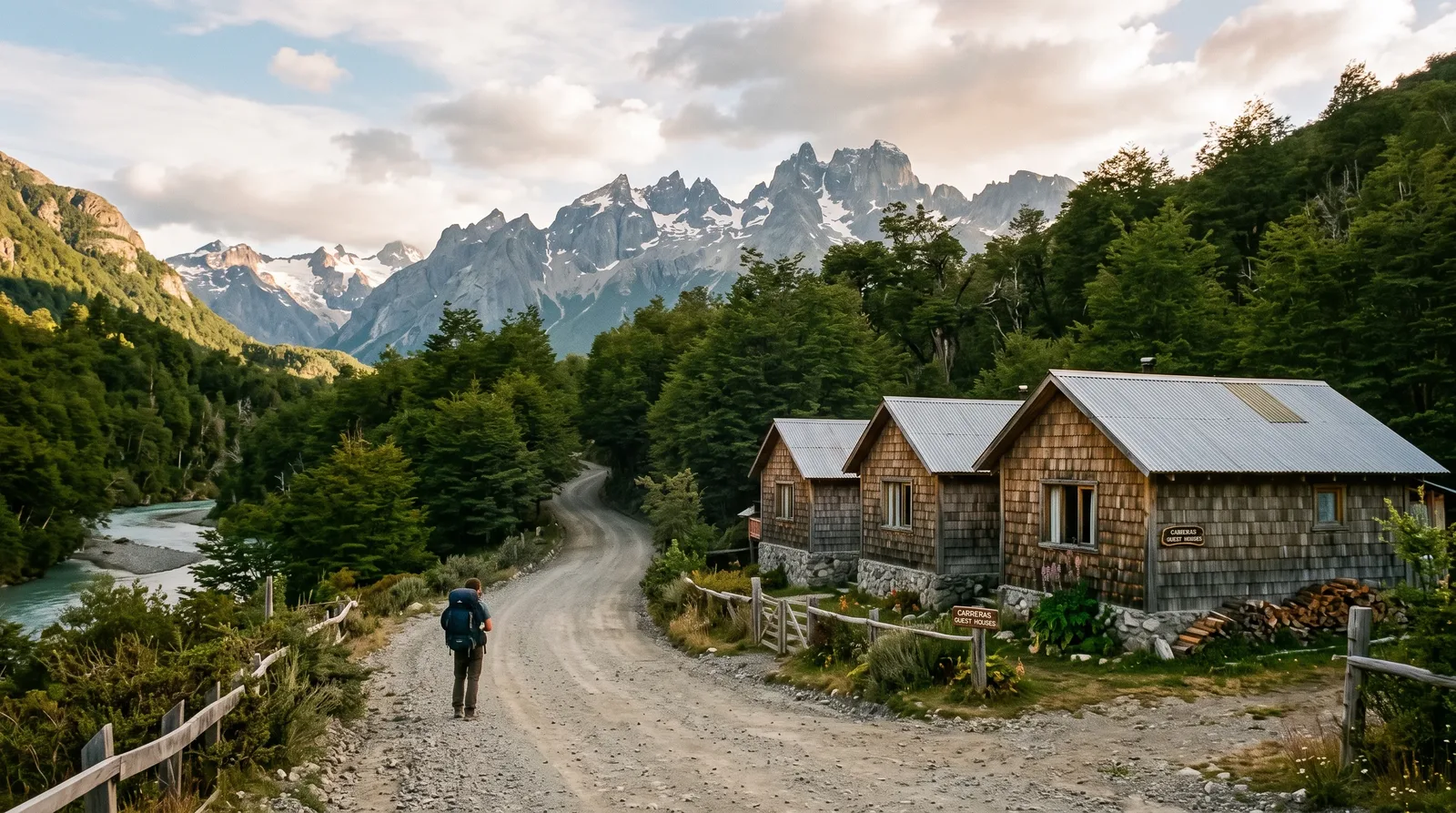 Cabin clusters along the Carretera Austral serve the summer caravan. See properties in Puerto Rio Tranquilo.
Where to buy: matching micro-markets to rental strategies
Aysen is not one market. Four zones, four different rental theses:
Coyhaique and Puerto Aysen. The only true year-round market, with administrative and commercial demand cushioning winter, and the destination that just posted Chile’s best February occupancy. Best for: hybrid strategies (nightly in summer, monthly in winter). Start with houses for sale in Coyhaique or apartments, and read our Coyhaique apartment price analysis first.
Puerto Rio Tranquilo and Lago General Carrera. The Marble Caves engine. Extreme summer compression: every bed within walking distance of the embarcaderos fills. Extreme winter silence. Best for: pure high-season plays with lock-up-and-leave cabins. See Puerto Rio Tranquilo and Puerto Guadal.
Cerro Castillo. The trekking boom village at the foot of Aysen’s most photogenic peak, one road hour from Balmaceda airport. Small, supply-constrained, growing. See Cerro Castillo.
Puyuhuapi and the Queulat corridor. Hot springs, hanging glacier, ferry traffic. The northern route’s overnight stop. See Puyuhuapi.
For the legal mechanics of the purchase itself as a non-Chilean (RUT, border zone myths, due diligence), our guide to buying property in Chile as a foreigner covers the full sequence.
Frequently Asked Questions
Can a foreigner without Chilean residency operate an Airbnb in Aysen?
Yes. Foreigners can own Chilean property and rent it out. You will need a RUT (tax ID), an SII registration for habitual rental activity, and either a local property manager or a representative for the sanitary and municipal paperwork. Non-resident owners face specific income tax withholding rules, so read our rental income tax guide for foreign owners and hire a Chilean contador.
Do I owe IVA if I only rent my cabin a few weeks per year?
Renting furnished is IVA-taxable regardless of frequency, but the SII distinguishes habitual from occasional landlords in how you declare: occasional hosts can declare directly on Formulario 29 with code 713 without formally registering a business activity. The 11% avaluo fiscal deduction applies proportionally to short periods, which often shrinks the bill substantially for low-value rural properties.
What happens if I just do not register with the SII?
Since October 2025 platforms must demand proof of tax registration from habitual hosts, and since January 2026 they must verify compliance. The SII also receives annual reports identifying hosts, properties and income through the DJ 1835 regime and platform data sharing. Informality now risks both tax assessments and losing your listing.
Is buying through a company better than buying personally for a rental?
It depends on your goals. Note that the DFL 2 income tax benefit now applies only to natural persons, so holding qualifying homes through a company forfeits it. Companies can make sense for multi-property portfolios, liability separation or succession planning. This is precisely the question to put to a Chilean tax advisor before signing, not after.
Can my condominium stop me from listing my Coyhaique apartment on Airbnb?
Under Ley 21.442, the building’s assembly can adopt rules regulating temporary lodging (guest registration, schedules, fines, common-area limits), and the prevailing legal interpretation is that they can regulate but not prohibit outright. Read the reglamento de copropiedad before you buy; since the 2025 implementing regulation, many buildings have updated theirs.
Does Aysen have enough winter demand to justify heating and maintaining a rental year-round?
Regional winter occupancy averages sit around 14 to 16%, so a pure nightly strategy struggles from May to September. Coyhaique is the exception: government, university and commercial travel plus remote workers sustain a medium-term furnished rental market. Many owners of remote cabins simply winterize and close, which the numbers say is rational.
Are Argentine tourists really a stable source of demand?
They are the region’s largest foreign segment (90,172 arrivals in 2024, up 70.1%), but that surge is documented as exchange-rate driven, which cuts both ways. Treat Argentine demand as upside, and anchor your model on the more stable flows: Chilean summer travelers, the international Carretera Austral circuit, and Balmaceda’s steadily growing air traffic.
Interested in buying land in Patagonia?
We connect buyers with the best opportunities in Chile's Aysen Region. Tell us what you're looking for and we'll help you find it.
No commitment. Your information is kept confidential.

Written by
Nicolas GorroñoFounder & Editor
Founder of Patagonia Properties. Grew up in Coyhaique, lived in Australia, and is now back in Patagonia full-time. SEO and digital marketing specialist.
LinkedIn